Know More
Publications
Advancing Knowledge on AI and Distributed Agency in Warfare
HuMach Publications
The HuMach project produces cutting-edge research that advances our understanding of the complex relationship between humans and machines in military settings. Our publications provide valuable insights into distributed agency, AI governance, and the ethical, legal, and operational challenges that arise from the use of AI in warfare. Below you will find our collection of peer-reviewed journal articles, policy publications, and other scholarly contributions.
Journal Articles
Our team regularly publishes in leading peer-reviewed journals in the fields of International Relations, Science and Technology Studies (STS), and military ethics. These articles explore the theoretical and practical implications of AI in military operations, including the ethical concerns surrounding human-machine collaboration, accountability, and the governance frameworks necessary for responsible AI use in defence.
Contribution to special forum
By Ingvild Bode
August 2025
Ingvild Bode contributed to the special collection “Myth, Power, and Agency: Rethinking Artificial Intelligence, Geopolitics and War”, published open-access in Minds and Machines. This collection explores how AI is reshaping war, sovereignty, and human agency by entangling technological experimentation with myth-making and geopolitical power. It includes contributions from Raluca Csernatoni, Dennis Broeders, Lise H. Andersen, Marijn Hoijtink, Elke Schwarz, and Jon R. Lindsay.
Policy Publications
HuMach produces a range of policy publications that summarise key findings from our research in an accessible ways. These reports are designed for policy-makers, military officials, and other stakeholders in AI governance, offering practical recommendations. These publications are grounded in rigorous analysis and draw on diverse insights gained through our in-depth academic research.
Collective Policy Brief
By Anna Nadibaidze
March 2026
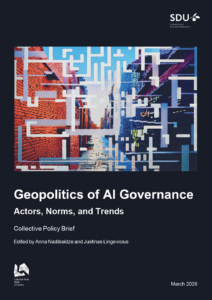
Anna Nadibaidze, together with Justinas Lingevicius (Vilnius University), co-edited the collective policy brief Geopolitics of AI Governance: Actors, Norms, and Trends, published by the Center for War Studies at the University of Southern Denmark. This collective policy brief brings together a new generation of International Relations (IR) scholars who analyse the rapidly evolving complexity of actors, norms, and trends related to AI governance, broadly defined. It features seven contributions written by early career researchers based at different European universities.

Policy Brief for the Center for International Governance Innovation
By Ingvild Bode
January 2025
Ingvild Bode wrote a policy brief entitled “Human-Machine Interaction and Human Agency in the Military Domain” for the Center for International Governance Innovation. The policy brief describes in accessible form what is at stake when we talk about human-machine interaction in the military domain: the emergence of a shared decision-making space between humans and AI technologies. The brief outlines how this distributed agency raises foundational, operational, ethical-normative, and legal challenges. It argues that militaries need to be aware of these challenges rather than only focusing on positive-sum outcomes associated with human-machine interaction.
Other Publications
In addition to journal articles and reports, our team contributes to a variety of other scholarly publications, including book chapters, conference proceedings, and other publications. These works aim to engage broader academic and policy communities, addressing emerging trends in military AI and their implications for international security and human rights.

LSE USAPP Blog
By Anna Nadibaidze
18 May 2026
Anna Nadibaidze wrote an op-ed about the United States’ use of AI technologies in its war against Iran for the LSE US Politics and Policy Blog. While the US conflict with Iran is not the first “AI war”, it does show the continuing concerns over how people work with technology to make military decisions. Anna Nadibaidze writes that while it can be easy to blame AI for intelligence failures, such mistakes are down to poor human judgement which can be made worse using AI. Questions about how the military use of AI is governed must keep sight of the continued importance of human decision-making in times of conflict.

RÆSON Article: Military AI and Responsibility by Design
By Ingvild Bode
January 2026
Ingvild Bode and Lena Trabucco (Centre for Military Studies, University of Copenhagen) wrote an article in Danish magazine RÆSON, examining the use of military AI-based systems and the challenges they pose to the role of humans in deciding when and how to use force. Drawing on high-profile contemporary wars, they explore how these systems shape decision-making and highlight the existing governance gap in the military domain. The authors conclude by advancing a ”Responsibility by Design” approach across the entire AI lifecycle to ensure meaningful human control, from system design to post-use review.